Business · Vendor Risk
Oracle Is Borrowing Tens of Billions for AI Data Centers. What That Means If You Build on OCI.
Oracle cut roughly 21,000 jobs in fiscal 2026 while capital spending on AI data centers nearly tripled, and reporting points to another round of cuts this month to help cover the bill. Here's the actual math and what it should change about vendor risk if you run on Oracle Cloud.

Anurag Verma
4 min read
Sponsored
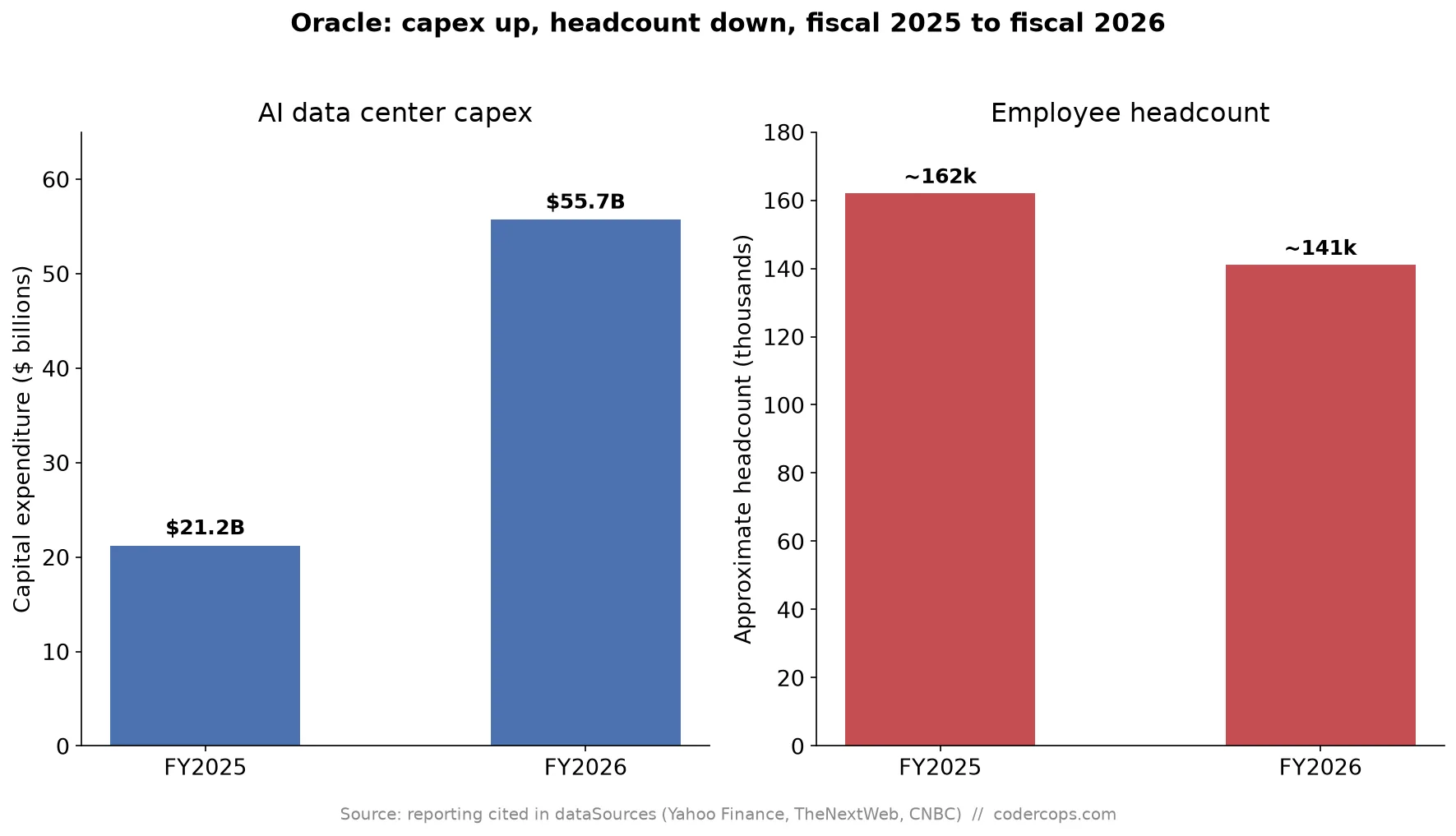
Two numbers from Oracle’s fiscal 2026 tell most of the story. Capital expenditure on AI data centers went from $21.2 billion to $55.7 billion, and headcount dropped by roughly 21,000 people, about 13% of the company. Reporting from mid-August says another round of cuts is planned before the new fiscal quarter starts on September 1. This isn’t a routine restructuring story. It’s a major cloud infrastructure vendor running a highly leveraged bet on AI demand, funded partly by payroll and mostly by debt, and if you’re building anything on Oracle Cloud Infrastructure, the financial mechanics behind that bet are worth fifteen minutes of attention.
The math behind the layoffs
Oracle’s fiscal 2026, which ended May 31, was the year the company committed hard to AI infrastructure. Capital spending nearly tripled year over year, and reporting describes the company’s cash outflow exceeding what it generated by an estimated $23.7 billion over the same period, a gap covered by roughly $43 billion in new debt and $5 billion in fresh equity, with more borrowing reportedly expected in the year ahead. Analyst estimates cited by financial press put the annual cash flow freed up by the layoffs at $8 to $10 billion, a real number but a fraction of the capex gap it’s meant to help close.
The division-level detail matters more than the topline. Two units, Revenue and Health Sciences and SaaS/Virtual Operations Services, reportedly lost around 30% of their staff, a scale of cut that changes how a team functions, not just its size. Reporting on the August round describes managers submitting lists of affected employees ahead of the September fiscal quarter, with some teams facing double-digit percentage reductions again, on top of the cuts already made earlier in the year.
Why this isn’t the usual “AI is taking jobs” story
Plenty of 2026 layoff coverage frames cuts as AI replacing workers directly. Oracle’s is a different mechanism: it’s a company borrowing tens of billions of dollars against future AI infrastructure demand, and cutting costs elsewhere, including headcount, to make the balance sheet work while that bet plays out. That’s a financial engineering story as much as an AI story, and it’s the specific pattern worth watching if a vendor you depend on is doing the same thing: capex growing faster than revenue, cash flow going negative, and layoffs timed to free up cash rather than to eliminate roles AI tools have made redundant.
What it means if you build on OCI
None of this is a prediction that Oracle Cloud is in trouble. Cloud infrastructure businesses run on committed, multi-year customer contracts, and Oracle’s AI-driven demand is real, which is the entire premise behind the spending. But a vendor running this much leverage has a different risk profile than one funding growth out of operating cash flow, and that’s worth pricing into how you architect around them, separate from any opinion about the product quality itself.
The practical version of vendor risk here looks the same as it does for any supplier carrying unusual financial strain: watch renewal pricing closely rather than assuming last year’s rate holds, pay attention to support response times as a leading indicator before a service-level problem becomes a crisis, and keep your own architecture from depending on OCI-specific primitives more than the product actually requires. The cloud-agnostic patterns we’ve written about before apply directly here: containerized workloads, infrastructure as code that targets a provider through an abstraction layer rather than hardcoded vendor SDKs, and data export paths you’ve actually tested, not just assumed exist. None of that requires believing Oracle is about to fail. It requires treating “our infrastructure vendor is carrying unusual financial risk” as a fact that changes your migration cost calculus, the same way you’d treat it for any other supplier.
The takeaway
A layoff wave tied to a capex spree isn’t automatically a red flag, most large infrastructure buildouts involve some version of this tradeoff, but the scale here (nearly tripled capex, a cash outflow in the tens of billions, headcount cuts reaching a second round in the same year) is large enough to warrant treating Oracle the way you’d treat any vendor whose financial structure changed materially since you signed the contract. If part of your job is advising clients on infrastructure decisions, this is exactly the kind of vendor-risk context worth raising before a renewal conversation, not after pricing changes or a service dip forces it.
Frequently asked questions
- How much has Oracle actually cut in 2026?
- Reporting on Oracle's fiscal year 2026 (which ended May 31, 2026) put total headcount reductions at roughly 21,000 positions, about 13% of the company, taking headcount from around 162,000 to about 141,000. Two divisions, Revenue and Health Sciences and SaaS/Virtual Operations Services, each reportedly lost around 30% of staff. Separate reporting from mid-August 2026 describes a new round of cuts planned before Oracle's fiscal Q2 begins on September 1, with some teams facing double-digit percentage reductions.
- Why is Oracle cutting jobs while spending more than ever on infrastructure?
- The two are directly connected, according to financial reporting on the company. Oracle's capital expenditure for AI data centers jumped from $21.2 billion to $55.7 billion year over year, and the company's cash outflow exceeded what it generated by an estimated $23.7 billion in the same fiscal year. Analyst estimates cited by financial press suggest the layoffs could free up $8 to $10 billion in annual cash flow, money that's being redirected toward the AI infrastructure buildout rather than payroll.
- How is Oracle paying for all of this if it's burning cash?
- Debt and equity. Reporting describes Oracle tapping debt markets for roughly $43 billion and raising about $5 billion more through stock issuance in fiscal 2026, with additional borrowing reportedly anticipated in the year ahead to keep funding a committed AI infrastructure spend near $50 billion for the fiscal year alone, reportedly $15 billion more than the company had initially told investors to expect.
- Should I avoid building on Oracle Cloud Infrastructure because of this?
- Financial leverage at a vendor isn't the same as a vendor about to fail, and Oracle's cloud business has real, growing demand behind it, which is the whole reason for the capex in the first place. The reasonable response is proportionate: treat a highly leveraged infrastructure vendor the way you'd treat any supplier carrying unusual financial risk, by keeping your architecture portable enough that a bad renewal negotiation or a service-quality dip isn't a crisis, not by assuming the worst outcome is imminent.
- What should I actually watch for as a warning sign?
- Price increases at renewal that outpace what competitors charge for comparable services, support response times degrading, and reduced investment in the parts of the product that aren't the AI infrastructure story getting the headlines. None of these are proof of anything on their own, but if you see more than one at once from any infrastructure vendor, leveraged or not, that's the point to seriously evaluate your migration options rather than after a bad surprise.
Sources
Sponsored
More from this category
More from Business
 R.01
R.01 IBM and OpenAI's Enterprise Deal: What It Means Beyond the Press Release
 R.02
R.02 Arc.dev Alternatives in 2026: When a Curated Marketplace Is and Isn't the Answer
 R.03
R.03 Braintrust Alternatives in 2026: What the No-Fee Model Actually Costs You
Sponsored
Discussion
Join the conversation.
Comments are powered by GitHub Discussions. Sign in with your GitHub account to leave a comment.
Sponsored